The Missing Muse
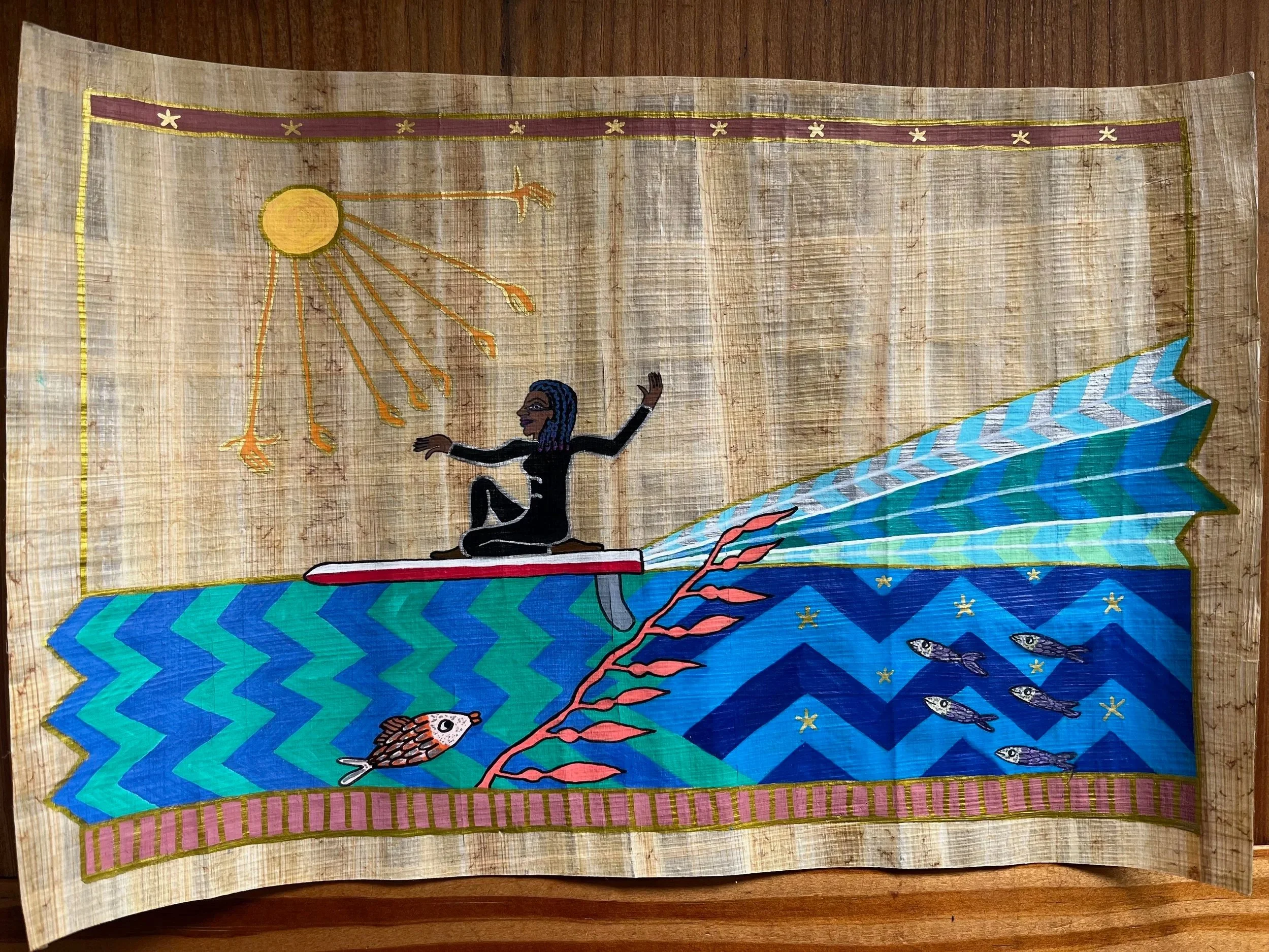
“Walk Papyrus” art by Dina El Dessouky
I have always been a water person, even at a young age. I grew up competitive swimming and my dad would have me wait for him on the beach at Scotts Creek (north of Santa Cruz) while he windsurfed during the weekends he had me (my parents were divorced). However, my interest in surfing really started at the Milpitas library, when I picked up a magazine in the teen section! While I rarely spotted an inspiring photo of women surfing in the surf magazines there at the time (it was the late 1990s), I remember one picture of a Native Hawaiian surfer, Kahea Hart, getting barreled at a break in Puerto Rico that mesmerized me because the wall of water faintly reflected the Rastafarian colors of his shortboard.
That same summer before my senior year of high school, I bought a longboard from a lifeguard coworker for $150.
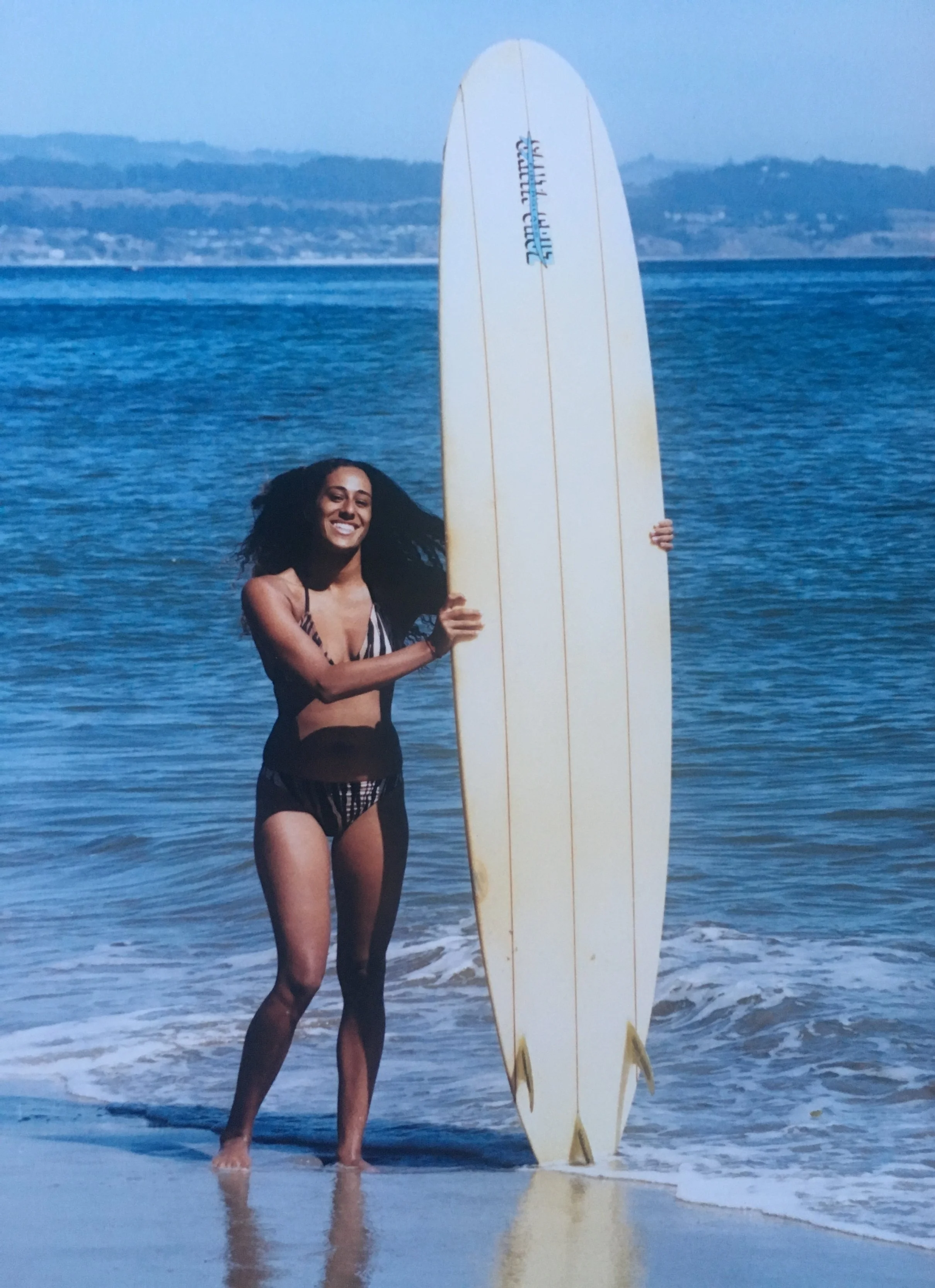
I didn’t have a car yet, so that posed a barrier since I lived in Milpitas, an hour drive to the waves in Santa Cruz. Luckily, my dad was fully supportive of my interest in surfing, so he agreed to drive us out there periodically. Our first stop in Santa Cruz was always Falafel of Santa Cruz because we’re Egyptian and Egyptians tend to love falafel, and also because he wanted to connect with other men who shared cultural affinities, and the owner at the time was Arab and Muslim, like my dad. We mentioned my plans to learn to surf and he said, “hey, you know, ask Gina where to go, she surfs!” Though I never got to know her, I remember Gina as this beautiful, young, Brown-skinned woman working there, and I later found out that she shortboarded competitively. My self-esteem wasn’t the highest at the time, so interacting with other surfers was very intimidating to me because I thought “I'm never gonna measure up to their level of coolness.” But I did ask her, and she told me that Cowell’s is a good place for beginners. So that’s where we went.
My dad put me in his long-john wetsuit with red astroturf-looking material on the inside. I paddled out on my longboard, my dad on a boogie board. The waves were soft and slow, and even back then it was crowded there! After that first day with my dad, I would paddle out alone whenever I could convince my dad to drive us out to the coast. I ended up a lot at the typically pretty mellow jetty in Half Moon Bay, because my dad coincidentally moved out there for a few years. I remember one incident in Half Moon Bay when I got totally worked on my longboard up at Francis Beach. I was actually in town for a swim meet, and because I got pitched so much in the shore break, the next day I competed with a tweaked back.
When I moved to UC San Diego for college, all I could bring on the long drive down was a shortboard. I met my awesome friend Jessica in the dorms, and like me, Jessica was still learning how to surf. So when our schedules aligned, we’d do the 30 minute walk together down the steep canyon to our closest break, Black’s Beach. Black’s is very challenging for people who are learning and if it's not tiny, it can actually be dangerous. We would get our asses whooped by the ocean on our shortboards and commiserate about it afterwards and motivate each other not to give up. If we could catch a ride in someone’s car we’d go down to Scripps or La Jolla Shores to surf the more mellow waves. Other than Jessica, there weren't many girls that I connected with. The ones who did surf were literally on the college surf team, and what I remember about that team is it was made up of mostly blue-eyed blond folks born and raised in SoCal beach towns. They were not trying to hang out with me. I think, preemptively, I just kept to myself to be honest. I was still trying to figure out how to catch waves and I was on the wrong board for me.
My progress as a surfer back then moved at a snail’s pace. Nonetheless, my sense of personal power came out the more time I spent in the ocean. As a kid and well into high school, I literally did not hold my head high and struggled with low self-esteem.
Being in the water and dancing with the waves gave my confidence level a big boost
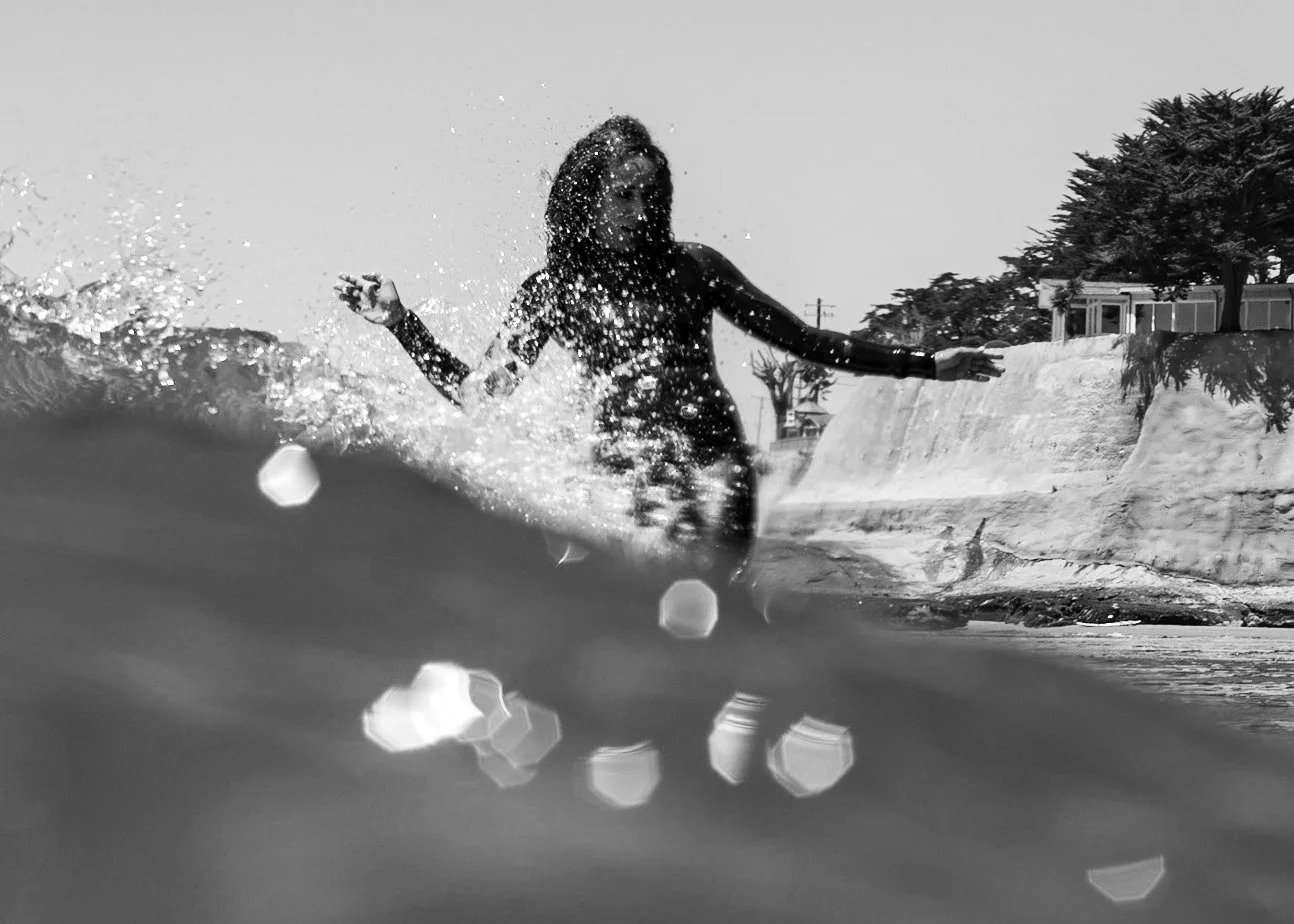
Because I loved surfing so much in my college years, I became actively curious about Native Hawaiian (Kānaka Maoli) culture and surfing’s roots. For my graduate studies I decided to pursue a path where I worked with Kānaka Maoli literature and culture. It was the Native folks that I was in relationship with during that time who taught me a lot about how to better respect and honor the natural world.
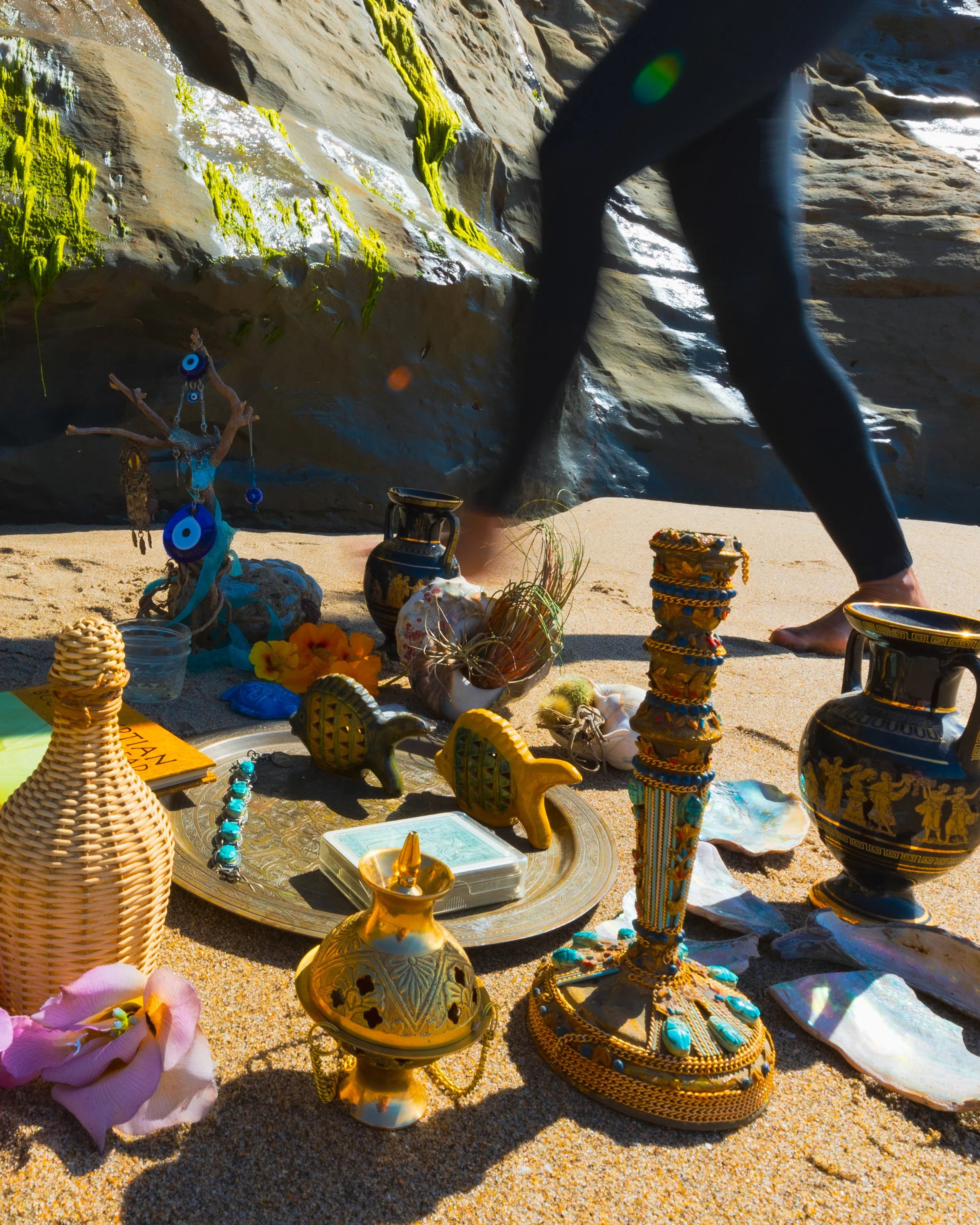
I learned the importance of acknowledging the ancestors of the places I visit, and of asking for their permission to enter as a guest. Kānaka Maoli put me on to this, and it has deepened my connection to place and sense of responsibility to the planet and all life. A big goal of mine is for my kids to have an even stronger sense of place-based connection than my own.
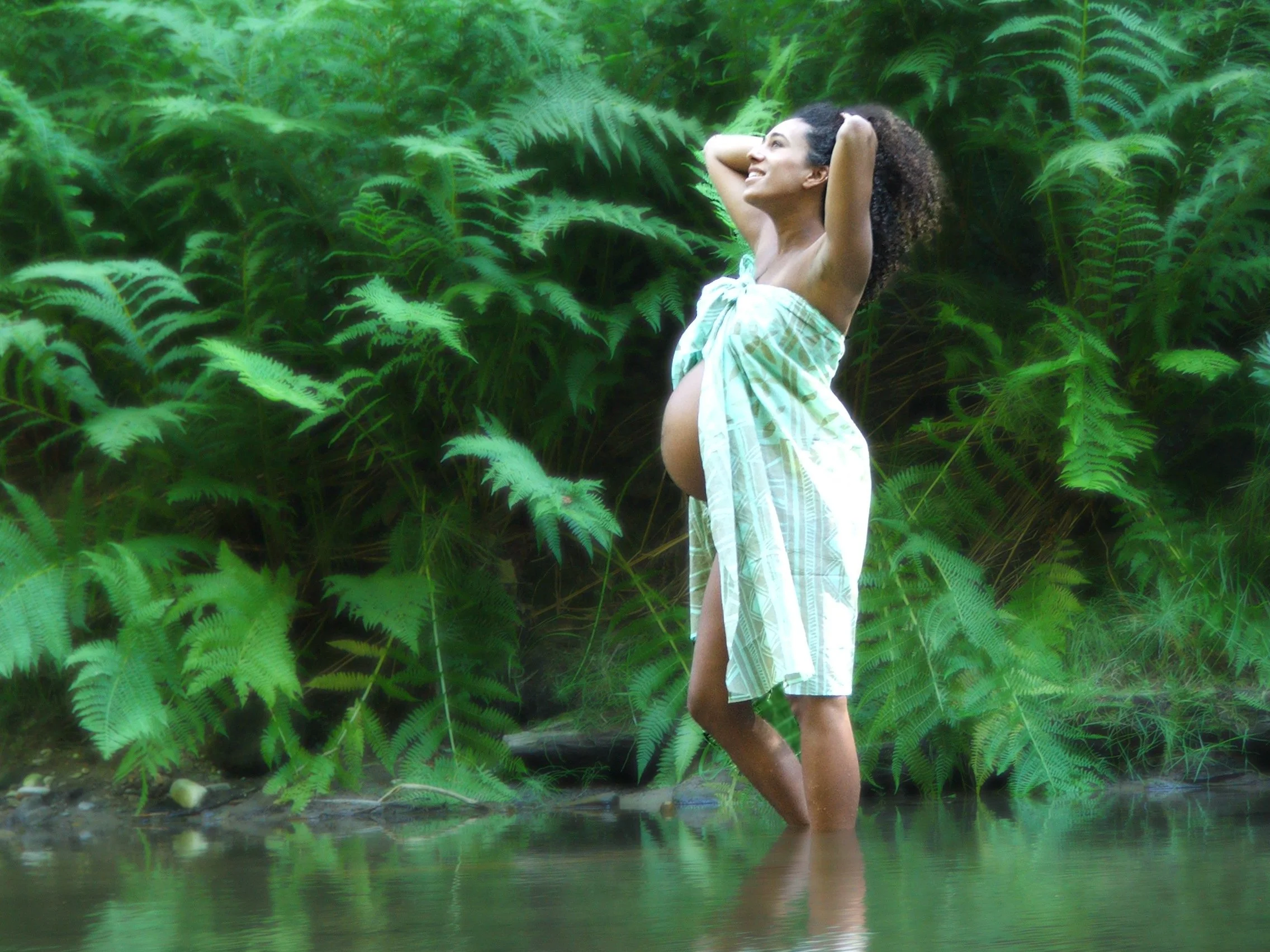
It’s hard for me to believe that Kanaka Maoli mommas weren’t surfing pregnant since time immemorial, but imagery of any women surfing—pregnant or not—was hard to come by when I started surfing in California in the late 1990s. The inspiring imagery of women surfing that I had back in college in the early 2000s came from a VHS tape I bought back in the day of the original Blue Crush and it was kinda my little Surf Bible, which I would rewatch religiously.
Even during my first pregnancy back in 2012, imagery of women actually surfing wasn’t as normalized as it is today, and it was pretty rare to find images of women surfing pregnant. Even without much imagery out there of women surfing—pregnant or not—it intuitively made sense for me to continue surfing on my fish and my shortboard until around five months. When I remember that time, I can still feel the soreness in my breasts whenever I’d lay on the board, and also the feeling of a firm little ball in my stomach as I paddled. When I hit my “pop-out” point of pregnancy (where growth becomes visible) around five months, hardtop boards were no longer comfortable for me, and knee-paddling didn’t work with my boards either, so I did some research online to see what other pregnant women did to keep surfing.
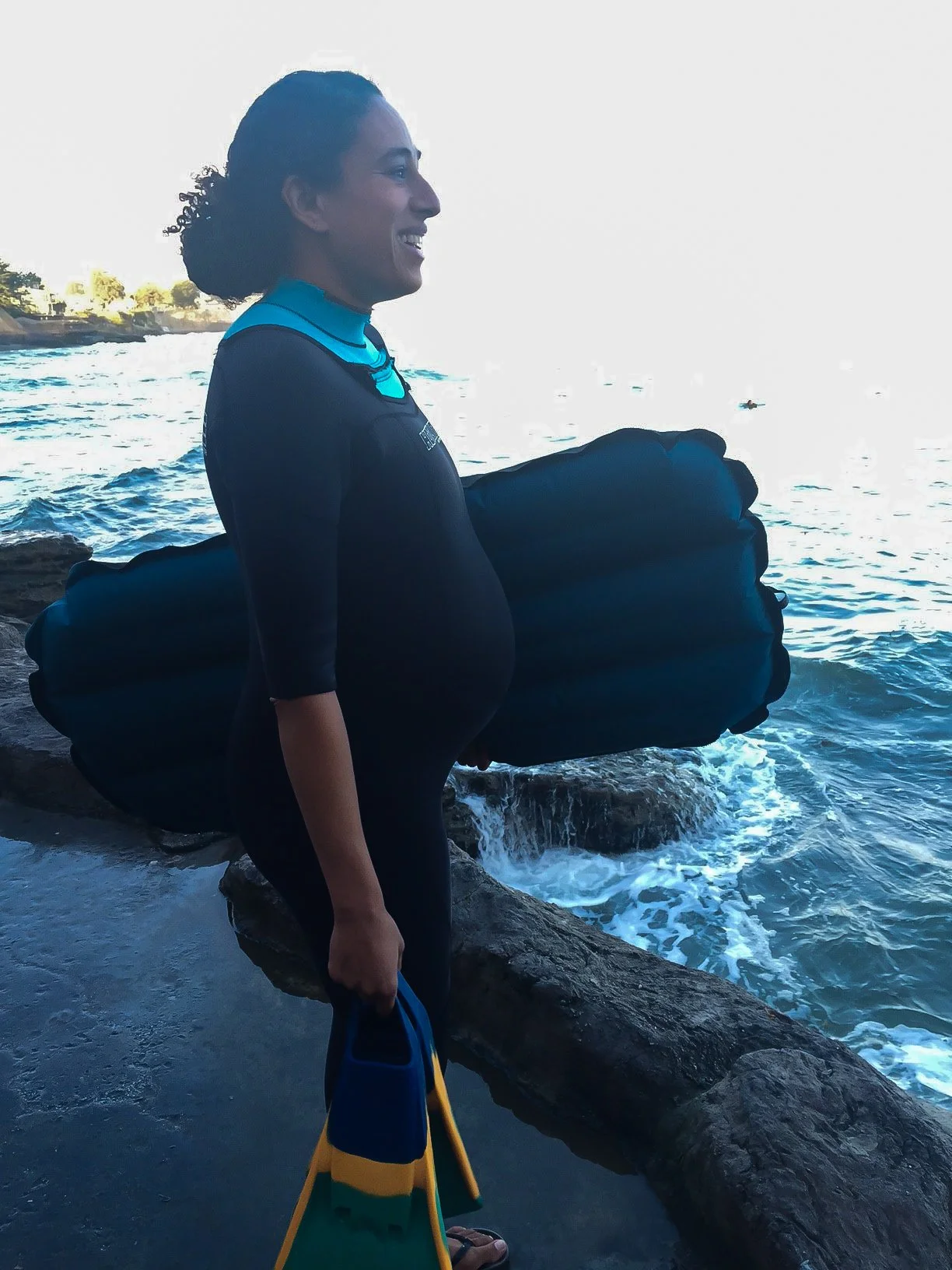
I found an English woman’s blog about how she continued by getting on a surf mat. Because I didn’t even know if I would like it, I bought a really crappy blow up mat that was essentially a poorly made beach toy. I loved the feeling, so I decided to buy a professionally crafted surf mat from Paul Gross in Paso Robles that I still use today.
As the pregnancy started to feel more real, I read a lot about pregnancy and birth; most notably, Spiritual Midwifery, by Ina May Gaskin. I learned about Gaskin through numerous birth-focused documentaries. Between the documentaries and Gaskin’s book, I realized home birth was as an enticing option. As a Black-presenting Egyptian, I had concern about the quality of care I would get in the conventional medical system. But I didn’t abandon it altogether and opted for tandem care, which meant hiring a home-birth midwife who would offer extensive appointments throughout pregnancy—and of course would oversee labor and delivery—while also having a few OBGYN appointments for the first 20 weeks of pregnancy.
My midwife was extremely knowledgeable and rational with my prenatal health. I intuitively trusted her. Both she and the OB encouraged me to continue surfing through pregnancy so long as I listened to my body and avoided collisions. My parents had reservations at the beginning, but nobody was like, “you can't go in the water.” Ultimately, they trusted my judgment, especially once they knew that my whole care team approved of me surfing. I think that’s what convinced them.
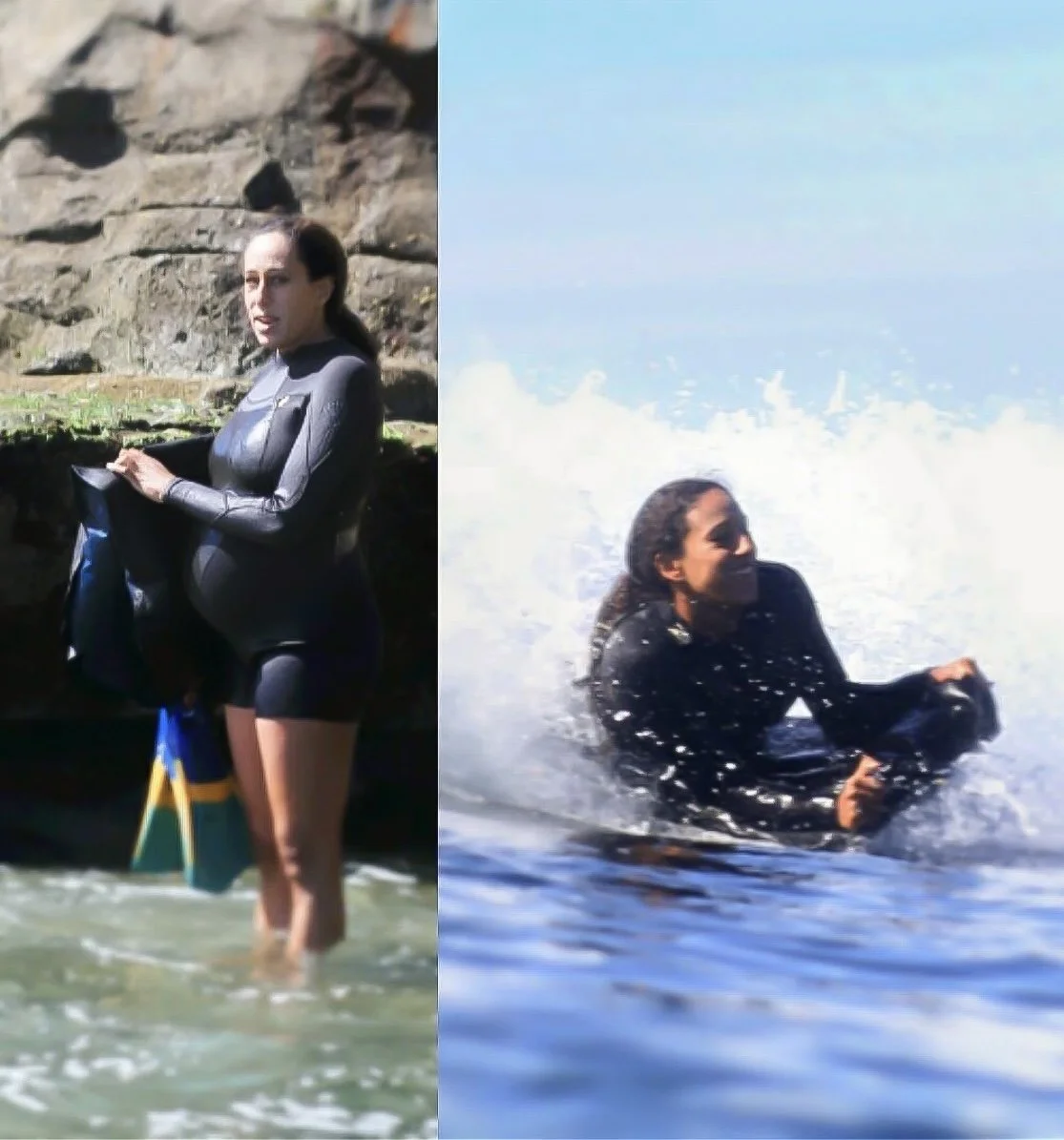
Interestingly enough, it was actually a few folks in the surf community who lectured me with unsolicited advice and commentary about surfing pregnant. Close to when my first child was born, there was a big south swell. I took out my mat and took off on some decent size waves at a peak that jacks up on that swell direction. I positioned myself away from the crowd like I always do. I had a lot of fun and for the most part, folks either supported me or didn’t notice my belly that was hidden in the ocean. However, I remember a fellow woman surfer frantically recounting to me that she thought I was “gonna have a placental abruption from bouncing around out there!”
Normally, I’d overthink comments like this, but pregnancy taught me to really trust my own intuition and risk assessment skills.
I surfed on the mat up until 3 days before the births of both my children, and I ended up having a home birth even though some friends and family thought that was too risky. For me, it never felt that by choosing a home birth or by choosing to surf pregnant, I was putting myself or my babies in a threatening situation. This is in part because the ocean teaches you to let go, and that you’re not always in control.
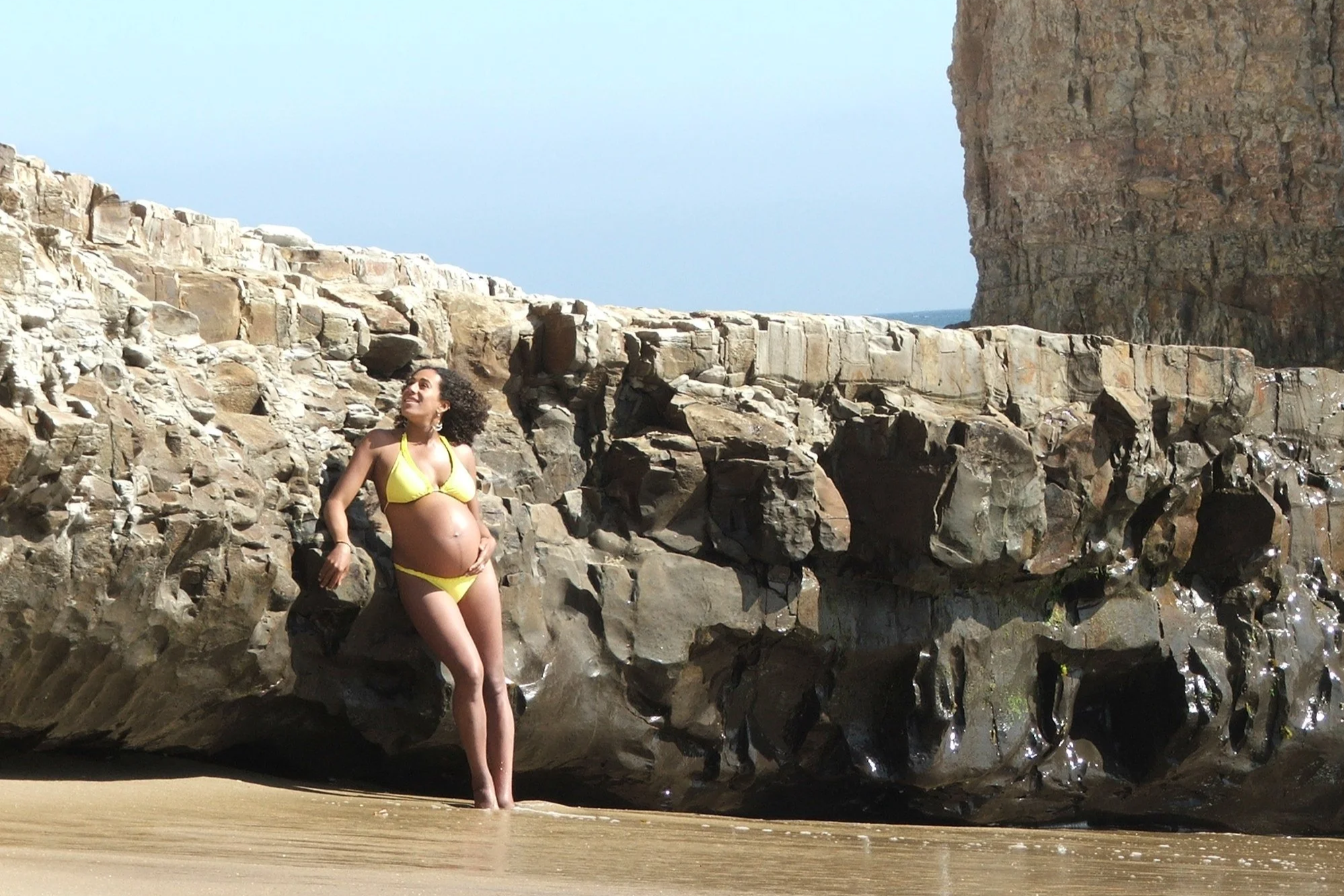
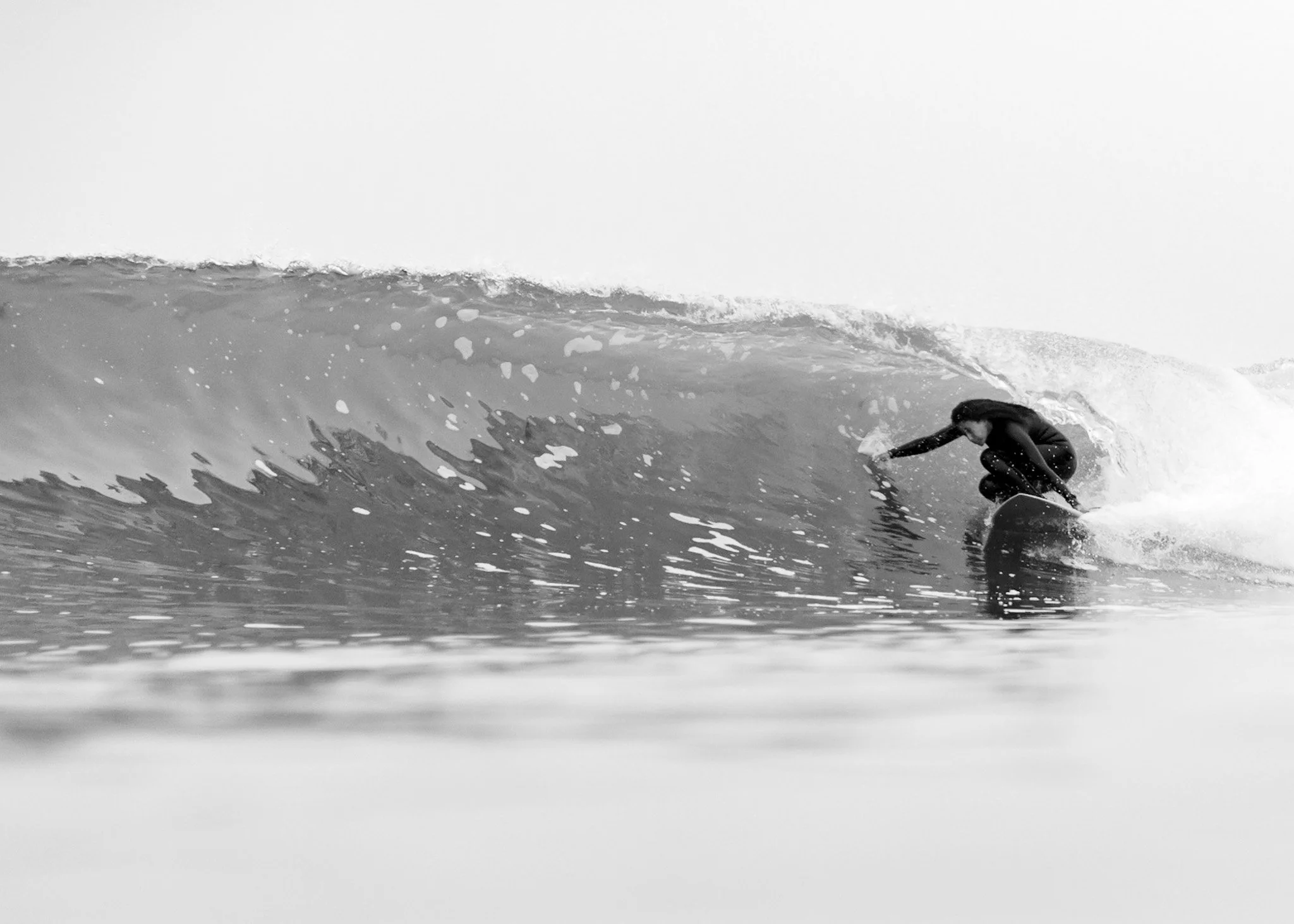
The ocean teaches you to simultaneously trust in yourself and in the powers of creation that are bigger than you
When the first labor began, the amniotic membranes ruptured first. The immediate concern was the risk of infection to the baby if contractions don’t start within 24 hours. I was worried, but knew my midwives had a plan. I was told to go to the acupuncturist to help stimulate contractions. Then, to bounce on a birth ball while doing nipple stimulation—that was a hilarious sight. Then they made me chug a disgusting castor oil root beer float, which turned me off to root beer for years, but ultimately brought nighttime contractions on, full throttle. I also remember the unexpected and terrible smell of salmon being smoked, because my husband was preparing that so we could all feast on it after the birth. This did not help during the 12 hours of back labor I had, where the contractions came just minutes apart but in short episodes. It felt like someone had a jackhammer on my sacrum because my baby’s spine was facing my spine. Bone to bone. It was gnarly.
Both of my midwives worked with doulas as part of their clients’ birth teams. I’m really grateful to my midwife and doula teams, but because of unforeseen circumstances with my first birth, I ended up feeling largely on my own for the majority of the birth. Apparently both I and another client unexpectedly went into labor at the same time, so the midwife in particular was bouncing around back and forth to care for both of us. Her other client needed to be transferred to the hospital, so my midwife spent most of the early part of my labor there advocating for the other momma. The doula—whom I hadn’t really gotten to know as well—was at the hospital for part of the time too. Midwives check in intermittently so that they are alert for us when birth is imminent. It’s hard to understand this when you’re living through the intensity of the moment. You’re in pain and at the mercy of fate, and I initially felt confused that there wasn’t more continuous support, because I thought that at least doula care is supposed to be continuous. It turns out that the doula was there periodically checking in on me, but the strategy was for her and my husband to not overextend themselves and to try to get any sleep they could in preparation for when it would be time to actually deliver the baby and care for them afterward. Since I was overwhelmed by the labor itself, what I remember most about that stage of the labor was being curled up in a ball alone and writhing.
So while I definitely had a moment where I thought “what the fuck?!” what got me through it was a combo of breathing and listening to the “Birthing through Hypnosis” tracks my midwife had connected me with on loop. Then around hour 20, the contractions eased considerably. My baby turned to a better position. I woke up at some point to the arrival of the midwife team and them feeding me the smoked salmon and other treats. This gave me the energy I needed to finally get into the birth tub and push for the three hours it took to get the baby out. I remember towards the end of pushing I must have looked sleepy, and the doula asked, “want a Coke? That’ll pep you up” and thought it was an odd recommendation.
But it turns out that between the long pushing period and everything that the midwife and doula suggested, our first baby was able to make it out safely,
and with little to no injury to me.
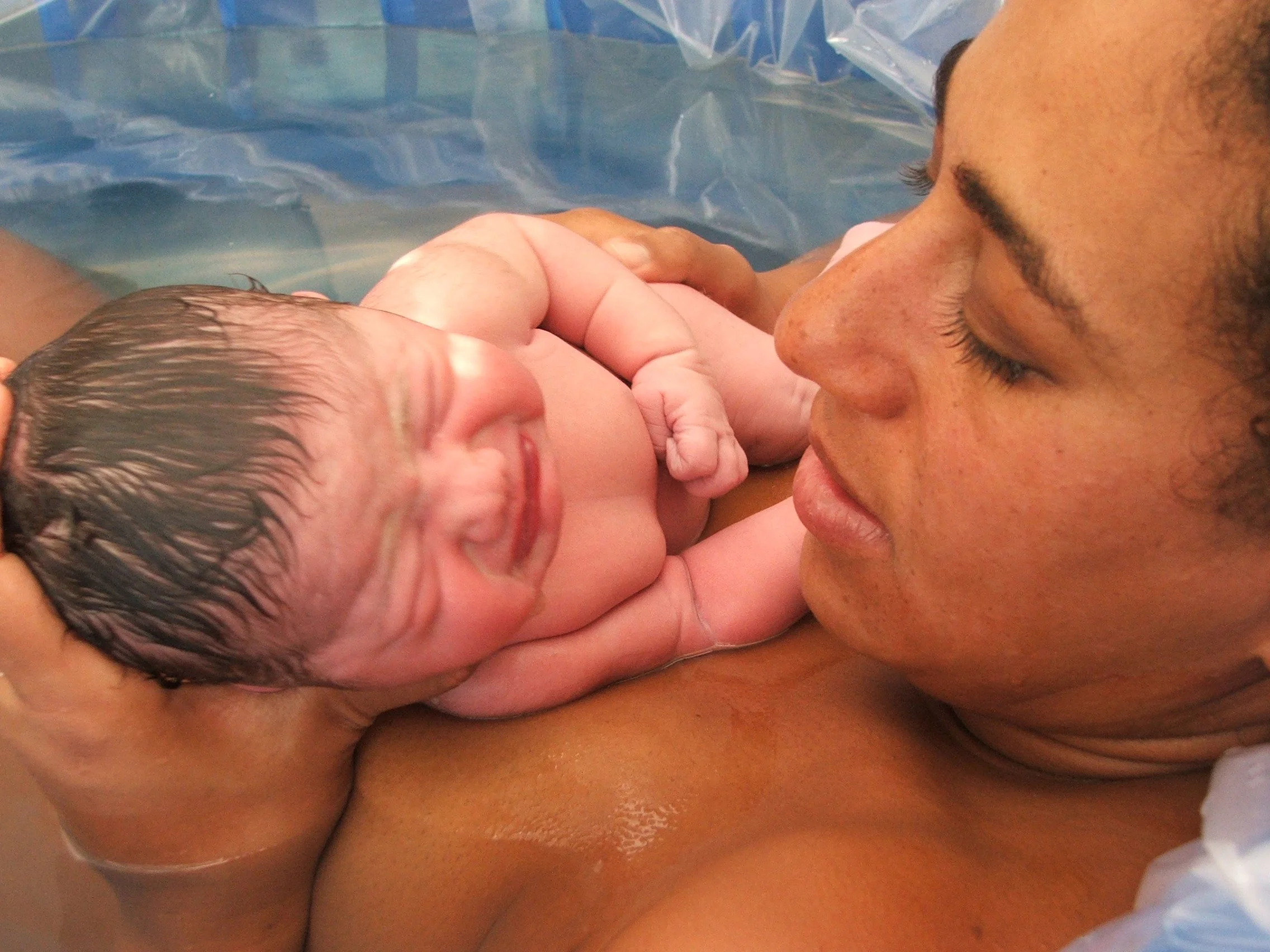
My experience with my first child led me to again chose tandem care with my second child, and encouraged me to surf whenever possible until the day she was born. Yet again, the membranes ruptured first, and it made me really worried that I was in for a repeat of all the challenges of my first labor. I felt on the clock, racing against infection risk. To my surprise, labor lasted just under 3 hours, with no excruciating back pain! I loved that. It was amazing. The only challenging part of pregnancy with my second daughter was that I mysteriously broke out in shingles about 6 months in while we were preparing to move to a bigger house. It was uncomfortable, but surfing on my mat and just being in the ocean got me through that time too.
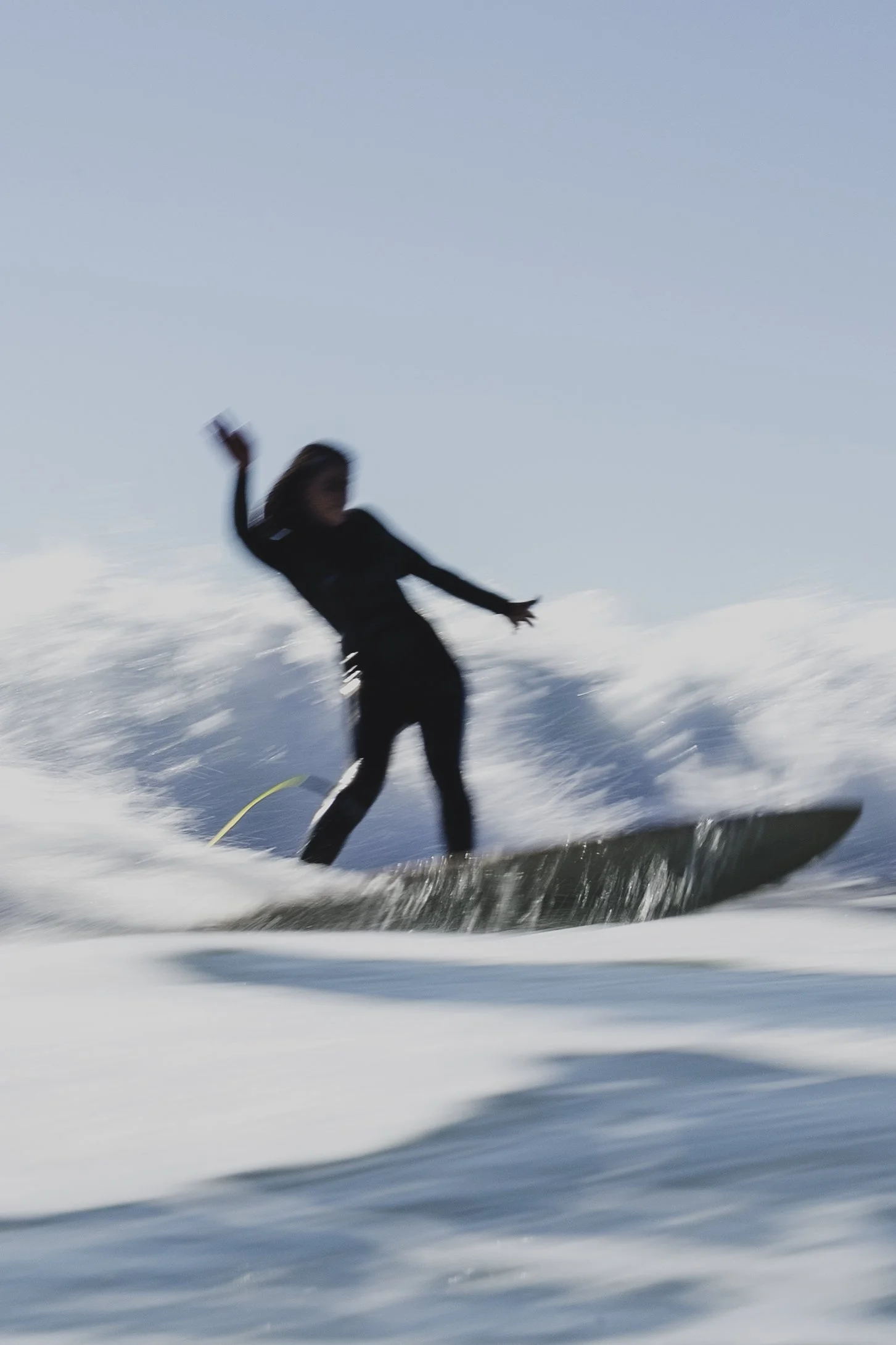
At the 6 week postpartum mark, both times, I was healthy enough to return to the water on the day. While it was awkward and being away from the babies was an adjustment at first, over time, I noticed that my surfing had matured.
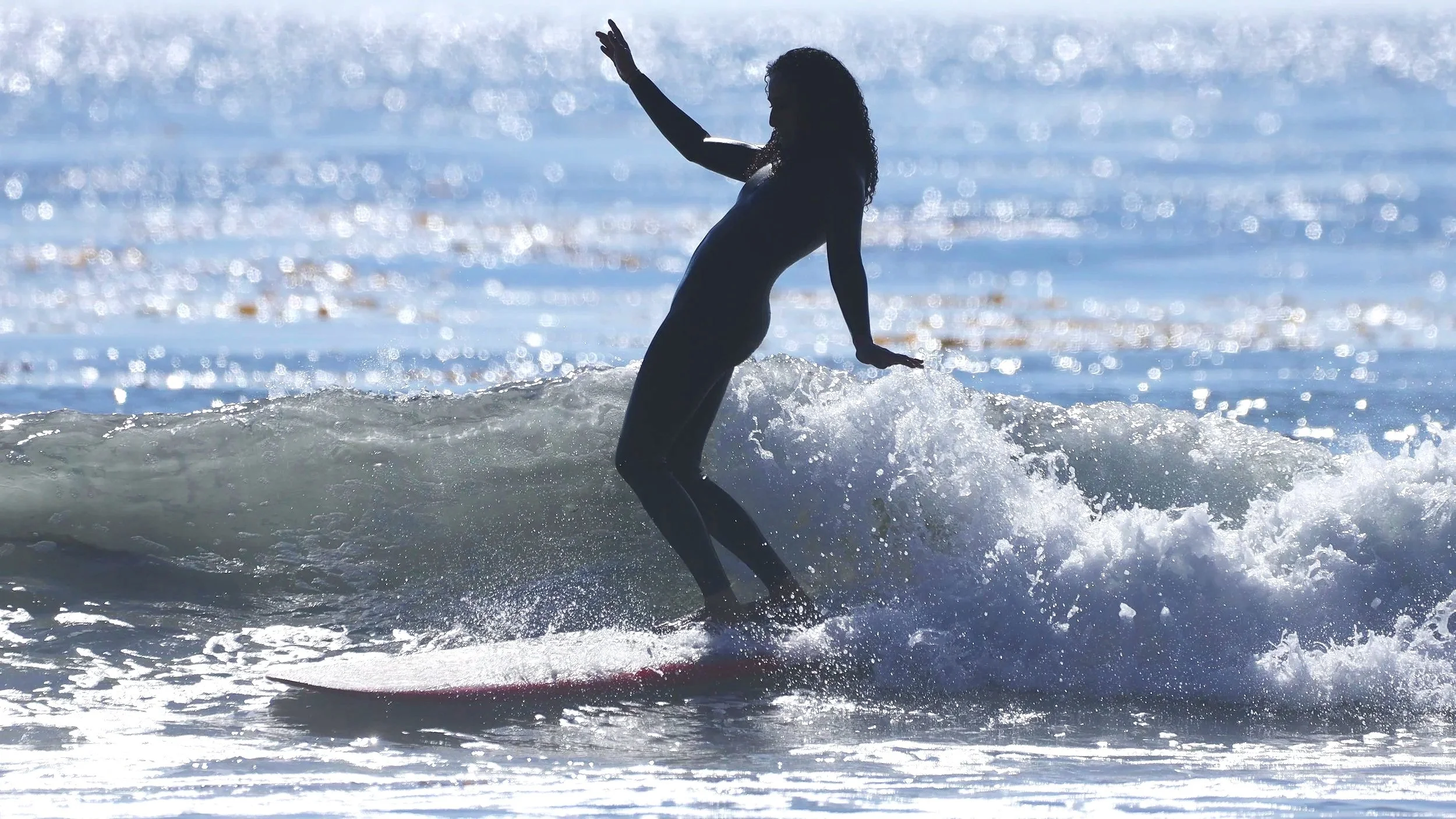
My identity formation—as a being in the water interacting with the waves—had shifted. There was a subconscious level of confidence and power that was born.
I know now what I’m capable of.
If waves are pushing double overhead I do get nervous; I’m not fully confident and calm. But my birth experiences have offered the gift of courage, especially when navigating unknowns. To decide on an unmedicated home birth, you have to put tremendous faith in your care team and their competence. Putting my faith in both myself and in something bigger than me helps me to go for it.
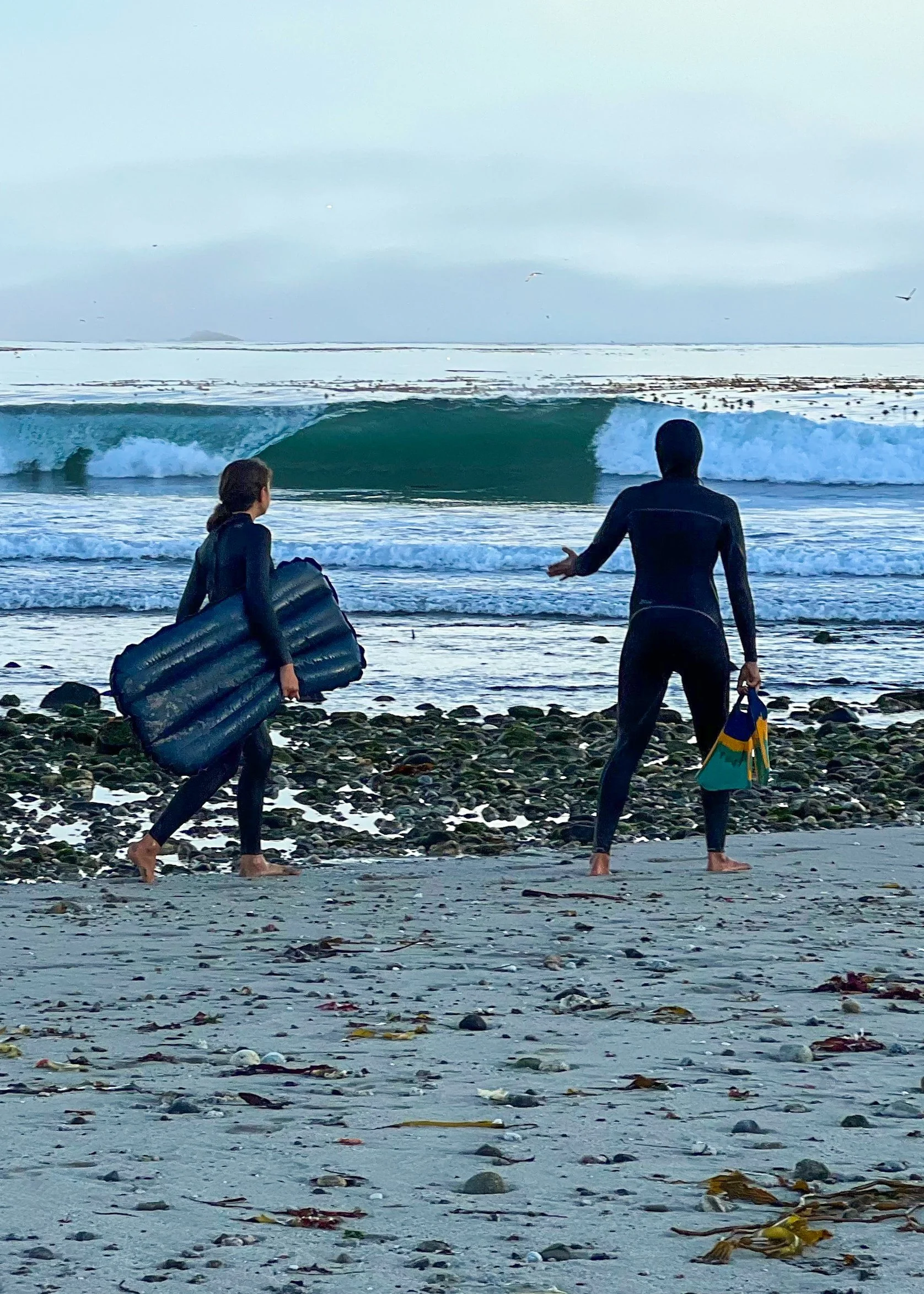
Ever since they were little, I’ve repeatedly offered my kids opportunities to surf with me or just play in the water. Periodically my youngest proactively seeks it. My oldest used to begrudgingly accompany us, but currently isn’t interested. Where their interest lands with surfing is not up to me.
But the end isn’t written. The bottom line for me is that they know the ocean is there for them, that they can have a meaningful relationship with the ocean.
Even once I am gone or if I am just far away, they can always connect with me through the ocean.
Born in Hamburg to parents from Cairo, Dina El Dessouky immigrated to the United States at age three. Dina teaches writing at the University of California, Santa Cruz, where she completed her doctorate in Literature.
Recently Dina wrote, produced, and starred in her film WALK “a story of rebirth and reclamation. Dominant histories and oppressive actors try to bury us, erase us, reduce us to invisibility, or render us one-dimensional; WALK asks us to challenge all of this, to dream new realities into being for our communities.”
Click the link to watch
Papyrus painting: Dina El Dessouky
Contributing Photographers:
Nahed Hamdi: photo 1 Olek Lyzwanski: photos 4, 7, 9, 11 Dave Brown: photo 6 (collage) Alaya Vautier: photo 5 Kaili Reynolds: photo 2, 3, 8, 10, 12
